Article|TSD-06A
Stop Asking the Slab to Fix the Soil
The k-value in your geotechnical report is probably a copied number from a 1942 asphalt chart. Here's where it came from, what it should be, and who owns the settlement it can't capture.
The Slab Designer, LLC | Published October 27, 2026 | Revised November 4, 2026
At a comical frequency, geotechnical reports in the U.S. say something like this: "The subgrade is assumed to have a CBR of 3 and, therefore, a modulus of subgrade reaction (k-value) of 100 psi/in. (27 MPa/m) for pavement and slab design."
I've asked around. I have yet to meet anyone who says CBR 3 equals a k-value of 100 psi/in. (27 MPa/m) because that's what their geotechnical textbook says. The usual answer is that it comes from PCA, ACPA, or ACI. In other words, from the concrete industry. The geotech may assume a low CBR to be conservative, but it's our correlation that turns that into 100 psi/in. (27 MPa/m).
So let's talk about where that number came from, what a k-value is actually supposed to be, and why the latest attempts to "fix" it by folding settlement into it make things worse.
A k-value is a spring, not a soil property
The k-value is a modeling parameter from Westergaard's pavement work in the 1920s. Push on the ground, measure how far it moves, and divide the pressure by the movement. It treats the soil as a bed of independent springs. That's it.
Karl Terzaghi, the father of soil mechanics, wrote the definitive paper on this in 1955. The title is "Evaluation of Coefficients of Subgrade Reaction." CoefficientS, plural. He made it plural on purpose, because a soil doesn't have one. The value depends on the size of the loaded area and how long the load stays. He was just as clear about what it's not for: "the theories of subgrade reaction should not be used for the purpose of estimating settlement or [permanent] displacements."
Bob Packard, whose PCA work was the reference on industrial floors before ACI 360 existed, defined k from a 30-inch (760 mm) plate "loaded to a deflection not greater than 0.05 in." Settlement was a separate issue. And a 2018 paper with the wonderful title "Plate Load Test: Getting It Right" put it plainly: k "is a stiffness parameter and must be estimated at deformations in which the load-deformation curve is generally linear."
Hold onto that. It matters later.
No joke: our CBR-to-k conversion came from a 1942 asphalt chart
The chart most of us carry in our heads (CBR 3 = 100 psi/in. [27 MPa/m], CBR 10 = 200 psi/in. [54 MPa/m], and so on; Figure 1) traces back to Middlebrooks and Bertram, who in 1942 published design curves for flexible (asphalt) runway pavements. They noted k-values ranging from about 100 for fat clay to about 800 for well-graded gravel and called them "considered only approximate." The axis was labeled for saturated soils in place, not soils compacted near optimum moisture the way our specs require today.
Somebody later built a nomograph from it for concrete design. That nomograph then propagated through PCA, ACI, ACPA, and many other publications. Look at footnote 6 on the k-value scale in the version ACI 360 still prints: it points right back to Middlebrooks and Bertram, 1942. The anchor points are a little too perfectly round, aren't they?
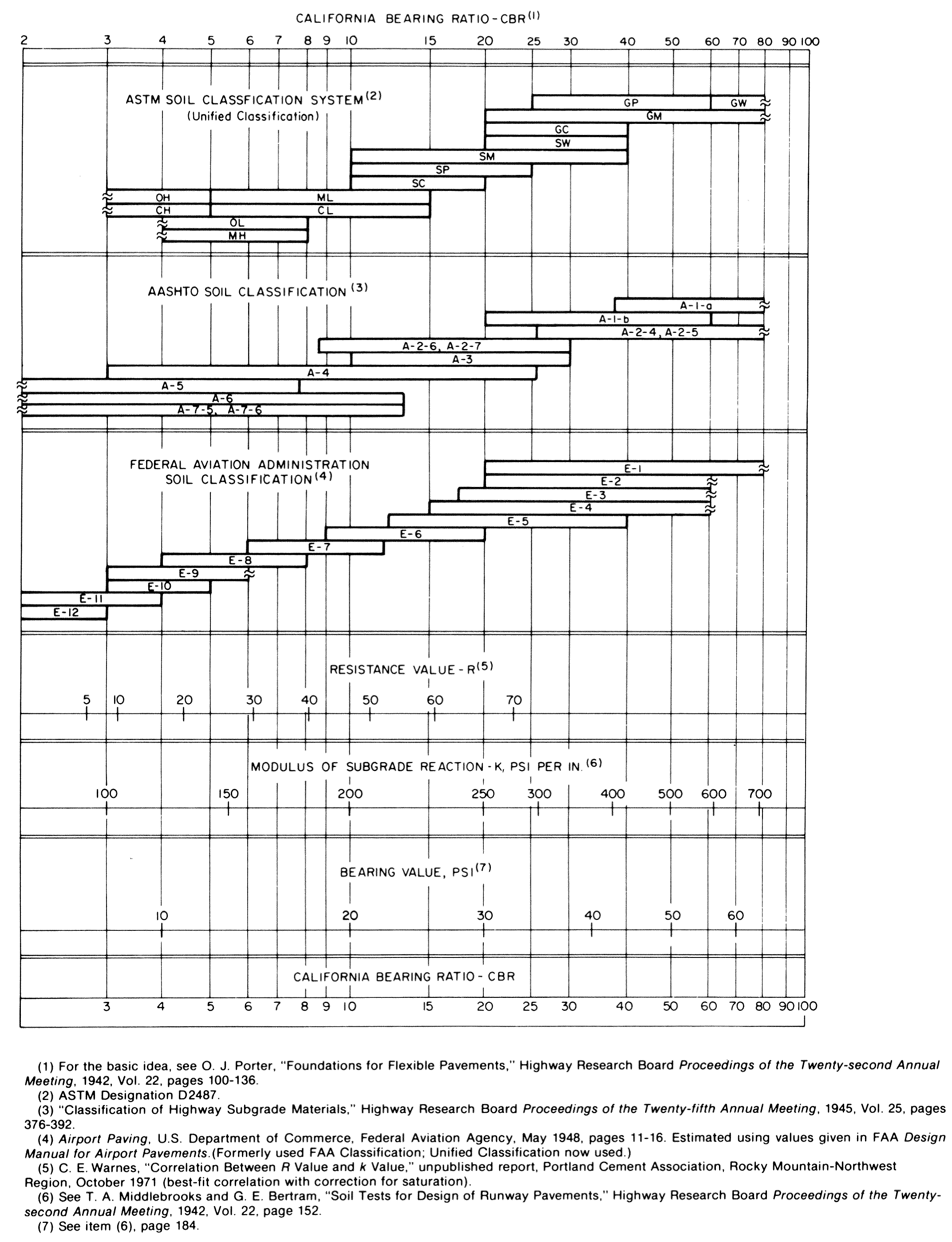
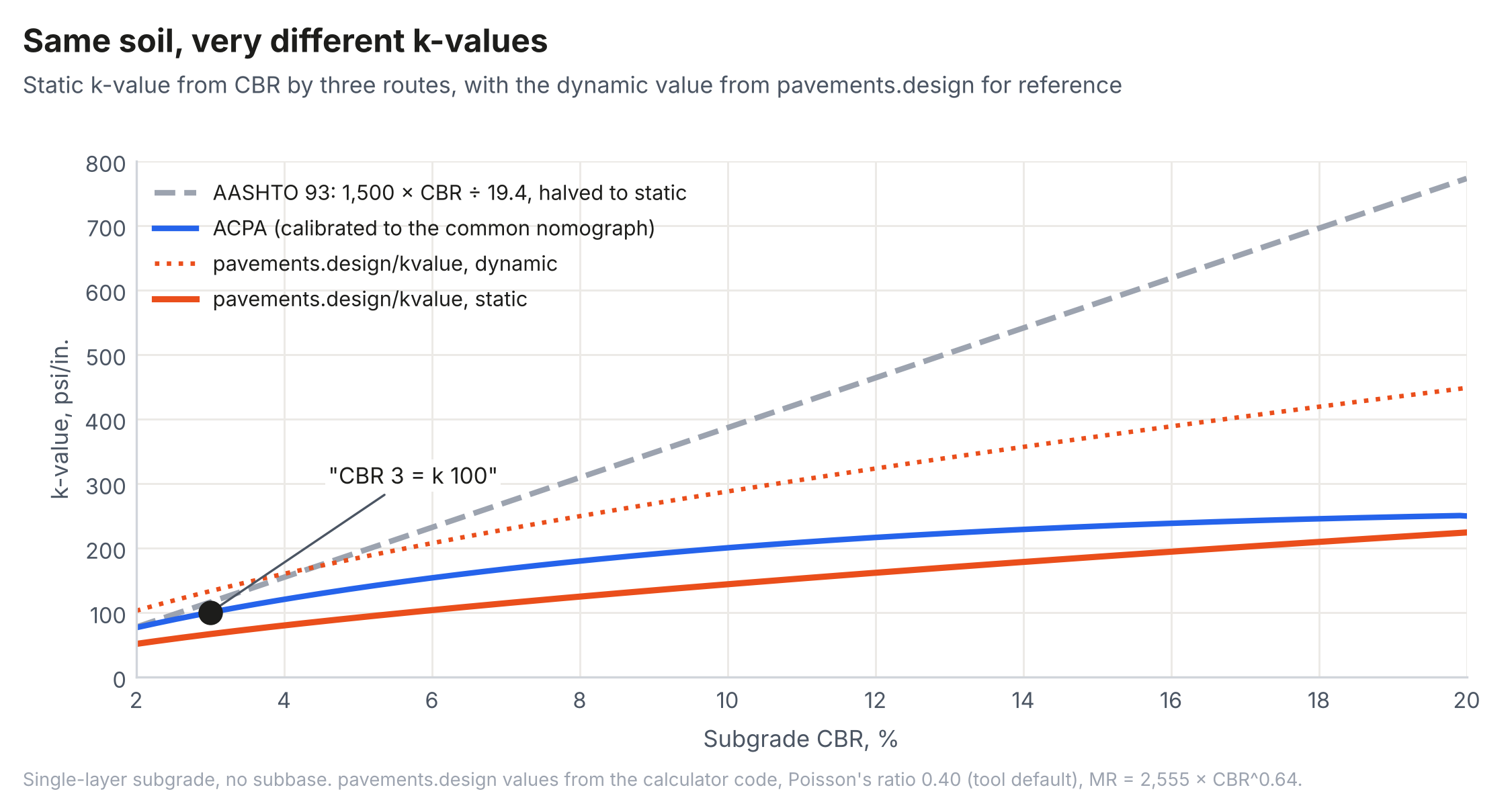
I say all this as someone who helped propagate it. When I was at the American Concrete Pavement Association, we updated StreetPave to run on newer versions of Windows and took the opportunity to use a newer correlation from CBR to resilient modulus. Combined with the AASHTO 1993 conversion from resilient modulus to k-value (divide by 19.4), it gave k-values that were too high for public opinion, because public opinion was anchored to the nomograph. Being good at Excel, I wrote equations that pulled the net result right back to the anchor points. That's what's in StreetPave12 and PavementDesigner.org today.
Sometimes we do our best with what we know. This was one of those times. It's OK for us to question it now and do better.
Two loads, two k-values
The most important distinction for a warehouse floor is time. A lift truck crosses a spot in a fraction of a second. A rack post sits there for years. The ground is stiffer under the quick load, and ACI 360R-10 says so: transient loads "produce smaller deformations than sustained loads; therefore, a higher k value can be used for rolling loads."
Pavement engineers have handled this for decades with two values. The dynamic k-value, what a falling weight deflectometer measures, runs about twice the static k-value from a plate load test.
So a slab designer should be working with two k-values: dynamic for moving wheels and static for racks and other sustained loads. That's how our SLABS software at The Slab Designer is set up, with the engineer able to override either one.
The most defensible way I know to get them
The free calculator at pavements.design/kvalue is the approach I now consider the most defensible. It converts CBR to resilient modulus with the Pavement ME correlation, treats the subgrade and any base layers as elastic layers, calculates the deflection of a rigid 30-inch (760 mm) plate, and applies a calibration. The equations trace from Burmister in 1945 to Palmer and Barber, Ullidtz, and finally Cañas Silva in 2010, whose thesis, supervised by Juan Pablo Covarrubias, calibrated it against Pavement ME and compared it to PCA and FAA plate test data. Covarrubias and his colleagues have since documented how that subgrade model, and the link between static and dynamic k, works in mechanistic design of concrete pavements. My guess is it hasn't caught on in the U.S. because that work is in Spanish and metric units, which hurts our American brains.
It reports a dynamic k-value and a static k-value that's half of it. It handles base layers directly instead of reading them off a decades-old table. And it's upfront about its limits, including the fact that it doesn't cover long-term consolidation. Its equations are the ones built into SLABS.
Here's the uncomfortable part (Figure 2). For a CBR of 3, it gives a dynamic k-value of about 133 and a static k-value of about 67. The magic number 100 is neither. It's too low for a lift truck and too high for a rack.
The "long-term k-value"
Here's where it gets out of hand. When I met recently with some of the top structural engineering firms in Atlanta, "long-term k-values" of 10 psi/in. (2.7 MPa/m) or less came up as a common conversation. Not because those firms were using numbers that low, but because they were hearing other engineers in the slab space push for them and wanted my opinion. For scale, you put about 10 psi on the ground standing flat-footed. Designing a slab on k = 10 psi/in. (2.7 MPa/m) says the ground would settle an inch under you if you stood there long enough. I've also seen engineers cut a k-value by 80% and then put that number into a Westergaard-based design, which violates the whole premise of Westergaard's framework.
The most complete published version of the long-term idea comes from Wayne Walker and Jerry Holland of Structural Services, Inc. (SSI), in two engineering bulletins. They deserve real credit, because much of what they say is right:
- They start with Terzaghi, and k does depend on the size of the loaded area.
- Short-term wheel loads and long-term rack loads need different values.
- The structural engineer owes the geotechnical engineer real information: loads, loaded areas, durations, and how sensitive the owner is to cracking and settlement.
- The geotechnical engineer should give k-values for each load case, not one unqualified number.
- A thin base layer helps wheel loads but does little for wide-area rack loads.
- Slab stress isn't very sensitive to k.
- And the way they get their reduced values is the right idea. Ioannides and Tingle, in their history of the plate load test, put the problem plainly: you need a k-value to design a slab, but you need a slab to backcalculate the k-value. SSI matched the slab stress from a spring model to a finite element model with solid soil. In other words, they built the slab in a virtual world to find its k. That deserves a pat on the back.
I agree with every one of those. Where we part ways is what happens next.
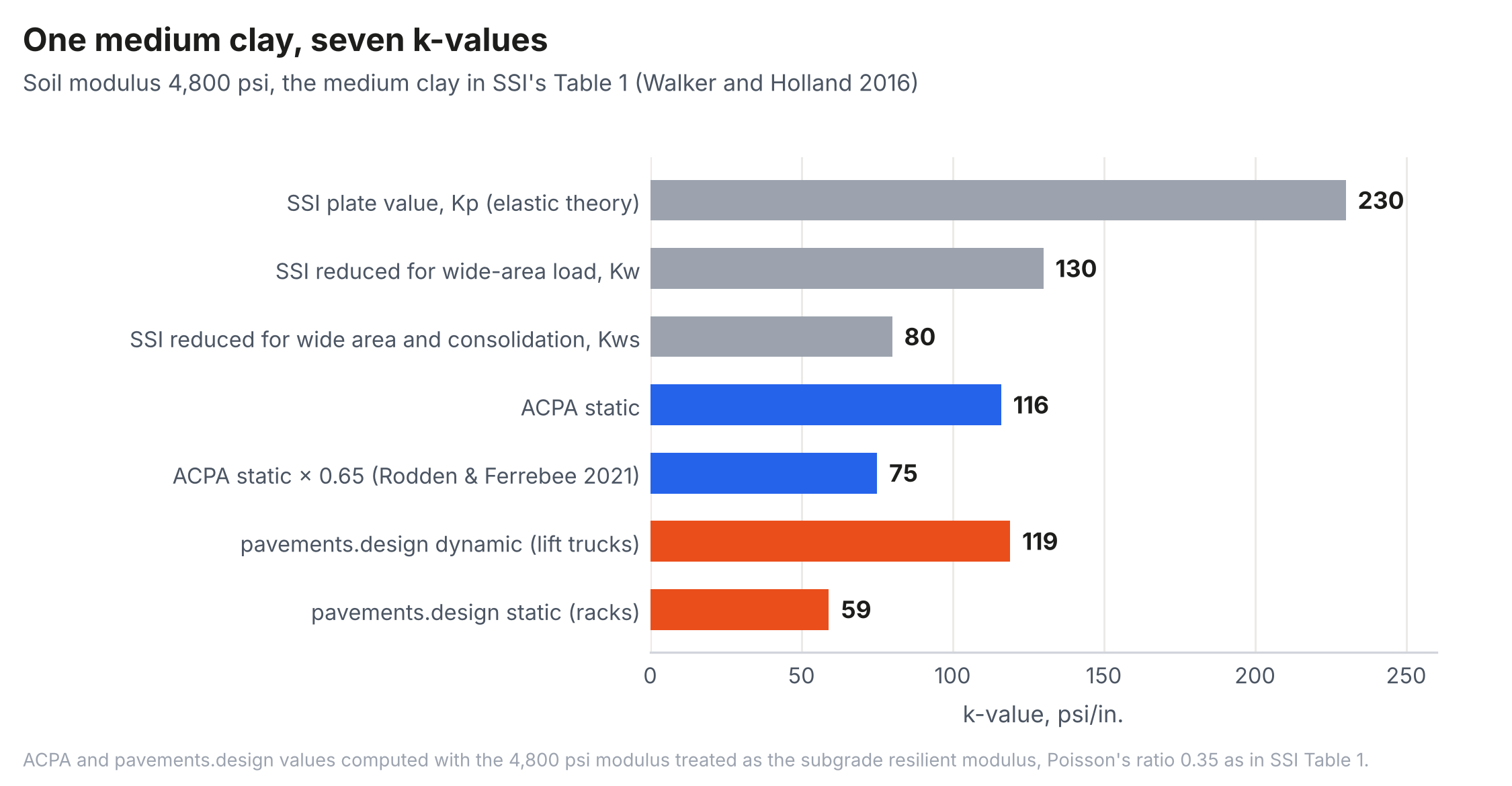
SSI's method starts with a plate k-value calculated from elastic theory and a textbook soil modulus, then reduces it for wide-area loading and again for long-term consolidation. For their medium clay, it goes from 230 to 130 to 80, which they describe as 35% of the plate value.
That sounds like a dramatic cut until you look at the starting point (Figure 3). SSI's 230 comes from the exact same rigid-plate equation that sits inside the pavements.design calculator. The calculator just calibrates it, and for a plain subgrade the calibration roughly halves it. Run SSI's own soil through the calculator and you get about 119 dynamic and 59 static. The elastic formula only captures the part of the movement that springs back, while a real static plate test includes the part that doesn't. So SSI's long-term value of 80 isn't a 65% reduction from a realistic static k. It's higher than one.
A k-value that hides settlement isn't a stiffness
Dividing a soil bearing pressure by a predicted settlement gives you psi/in., the same units as k. So does density. Nobody designs a slab on the density of the dirt. Follow the settlement logic and it gets silly fast: if 3,000 psf (140 kPa) settles 0.01 in. (0.25 mm), your "k" is over 2,000 psi/in. (540 MPa/m); at 0.21 in. (5.3 mm), it's under 100. And if the soil heaves instead of settling, is the k-value negative? Laughable stuff, but same logic.
It's not just a units problem. It changes the answers.
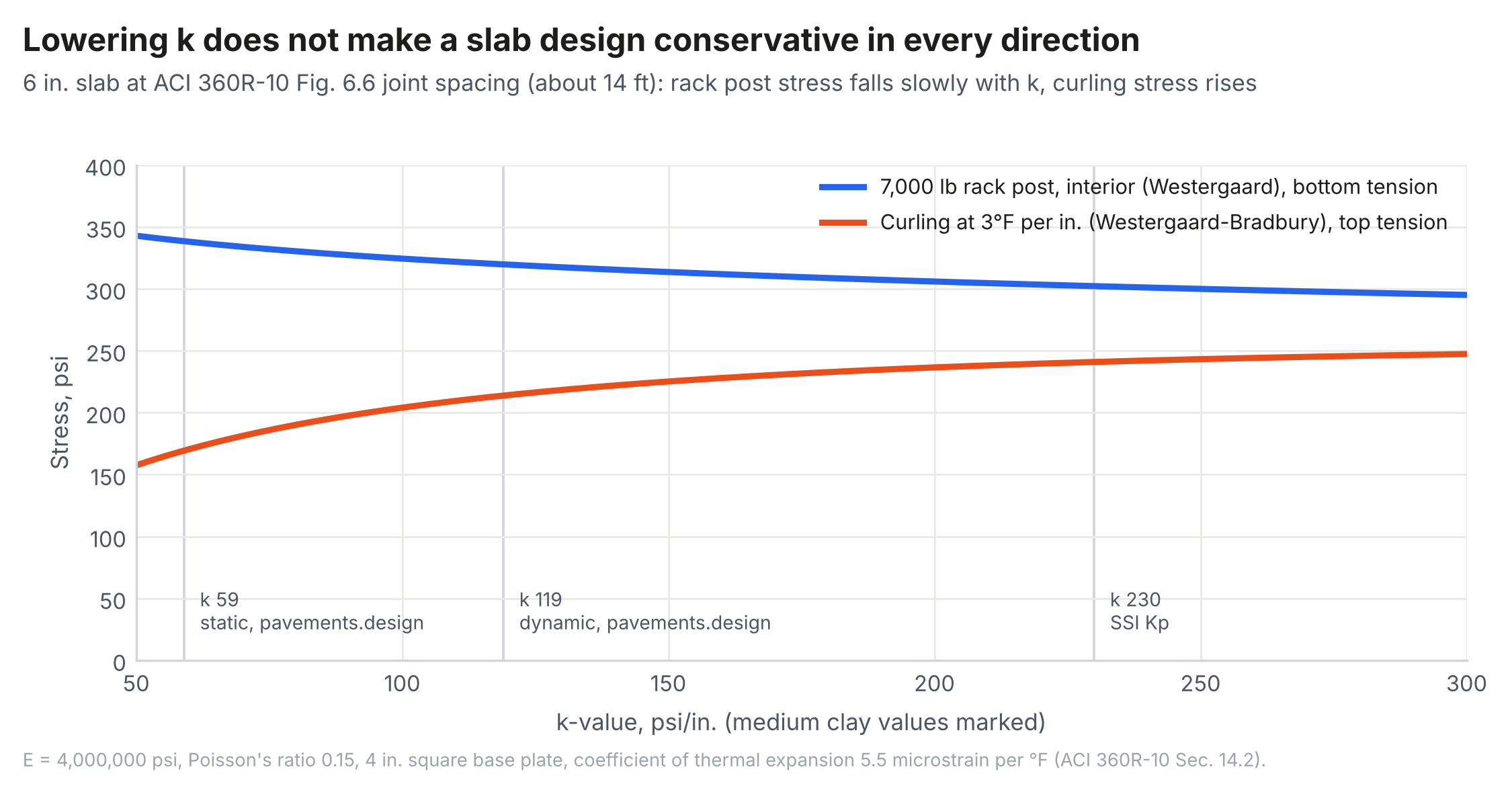
It understates curling. A lower k-value raises the calculated stress under a rack post a little, but it lowers the calculated curling stress, because the softer the springs, the less the slab's own weight pulls its curled edges back down (Figure 4). Curl is driven by the slab's weight and the stiffness of the ground right under it, not by consolidation 14 feet (4.3 m) down. In SLABS we deliberately go the other way: we check top-down cracking with the slab curled and bottom-up cracking with the slab flat on the same k-value, so curl can't hide load stress.
A thicker slab doesn't reduce settlement. I ran the numbers with Terzaghi's own equivalent-footing approach. A 10,000 lb (44 kN) load on a 7-inch (180 mm) slab at k = 100 psi/in. (27 MPa/m), versus a 9-inch (230 mm) slab at an arbitrarily lowered k = 50 psi/in. (14 MPa/m): the thicker slab spreads the load over a bigger area, but the predicted average settlement of the two is within 3%. You thickened the slab almost 30% and bought essentially nothing for settlement. Who does that benefit, besides whoever's selling the concrete?
It adds load. Concrete is heavy. Every 2 inches (50 mm) of thickness adds about 25 psf (1.2 kPa) of permanent pressure on the soil. If consolidation is the problem, the thicker slab adds to the weight driving it. And with the same differential settlement, a thicker slab opens its joints and cracks wider at the surface.
A friend of mine describes it with glass and elephants. Think of the concrete as a sheet of glass, because it's brittle too, and the loads as elephants walking across it. It doesn't matter how thick the glass is if it's only supported in the middle and the elephants walk out to the edges. What the glass needs is uniform support.
How the guide got here
ACI 360R-92 said it plainly: "consolidation of the subgrade is beyond the scope of this report." It even showed a worked plate load example with real numbers. The 2006 and 2010 versions dropped that scope statement, replaced the example with a sketch that has no units and shows two different k-values for the same test, and added a line saying settlement "typically indicates an equivalent k value of only 20 to 30% of that measured by a plate load test."
There's no reference given for that 20 to 30%. I've been told that engineering without peer-reviewed references can't go into the next version of ACI 360. Statements like this one suggest otherwise.
Who owns what
Here's how I'd draw the line.
The slab designer owns the static and dynamic k-values: the stiffness of the ground and base under quick and sustained loads, chosen with an understanding of how sensitive the design is to them. ACI 360R-10 says the thickness calculation is "insensitive to small changes in k." True for load stress, and a reason to pick a defensible value, not a reason to pick any value.
The geotechnical engineer owns long-term settlement. Total and differential settlement under the actual rack layout and storage loads is a soils question. If it's acceptable to the owner and the racking, design the slab on its static and dynamic k-values. If it's not, the answer is in the ground: remove and replace, surcharge, preload, improve the soil, or build a structural slab on foundations under ACI 318. Thickening a slab-on-ground isn't on that list.
That line matters for liability too. A reduced long-term k-value quietly moves settlement risk from the geotechnical engineer to the slab designer, without moving any control over the soil or any tools to evaluate it. I get why it happens. Geotechnical scopes have been squeezed for decades, borings are spaced farther apart than they used to be, and owners often want "a geotech report" more than they want a recommendation that balances risk and cost. But that problem shouldn't become the slab designer's liability. Slab designers need to speak up about the limits of what they're accepting.
What to ask on your next project
- Is the k-value in the geotech report measured, calculated, or copied? If it says "CBR 3 = 100 psi/in. (27 MPa/m)," ask which k-value that is: static or dynamic.
- Does the slab design use different k-values for lift trucks and racks?
- Did the geotechnical engineer evaluate long-term settlement under the actual rack and storage layout, and is it within what the owner and racking can tolerate?
- If settlement is a concern, is the fix in the soil, or is someone proposing a thicker slab to carry it?
The slab can do a lot. It can't fix the soil underneath it. That job belongs to the people who sample it, test it, and stand behind it. And if there's a better simplified k-value method out there than the one I've described, share it. I'm all ears, and we'll build it into the next tool.
Sources
ACI Committee 360, ACI 360R-92, Design of Slabs on Grade, American Concrete Institute, 1992.
ACI Committee 360, ACI 360R-10, Guide to Design of Slabs-on-Ground, American Concrete Institute, 2010.
Cañas Silva, J. T., Método de Cálculo del Módulo de Reacción "K" para un Sistema de Fundación Multicapas para Pavimentos de Hormigón, Memoria de Título, Universidad de Los Andes, Santiago, 2010 (supervisor: J. P. Covarrubias Vidal).
Covarrubias Vidal, J. P., et al., "Modeling of Subgrade for Thin Concrete Pavement," Technical Paper, TCPavements, 2020.
Anyang, M. Y., et al., "Plate Load Test: Getting It Right," 49th GhIE Annual Conference, 2018.
Middlebrooks, T. A., and Bertram, G. E., "Soil Tests for Design of Runway Pavements," Proceedings, Highway Research Board, Vol. 22, 1942.
Packard, R. G., Slab Thickness Design for Industrial Concrete Floors on Grade, IS195, Portland Cement Association, 1976.
pavements.design, k-Value Calculator, https://pavements.design/kvalue, 2026.
Rodden, R., and Ferrebee, E., "Analysis and Evaluation of the Development of Various k-Values for Use in Design," Proceedings, 12th International Conference on Concrete Pavements, 2021.
Terzaghi, K., "Evaluation of Coefficients of Subgrade Reaction," Géotechnique, Vol. 5, No. 4, 1955.
Walker, W. W., and Holland, J. A., "Modulus of Subgrade Reaction - Which One Should be Used?" Engineering Bulletin, Structural Services, Inc., 2016.
Walker, W. W., and Holland, J. A., "Modulus of Subgrade Reaction for Storage Racking on Slabs-on-Ground Made Easy," Engineering Bulletin, Structural Services, Inc.
Related in This Series
- Technical paper on this topic: The Modulus of Subgrade Reaction for Slabs-on-Ground
Compares CBR-to-k correlations with a calibrated elastic layered method and evaluates the SSI long-term k-value approach.
- The Floor Design Guide That Calls Its Own Results Erroneous
What owners should know about the trap built into the industry's main slab design guide.
- Two Promises in the Floor Design Guide That Curling Breaks
The guide says its joint spacing keeps curl low and its factor of safety covers the rest. Its own numbers say otherwise.
- The Design Guide a New Engineer Can't Design From
A new engineer follows ACI 360R-10 step by step and finds the places it raises an issue and stops.
- Spec Building Floors: Why Undoweled, Doweled, and 0.1% Steel Slabs Should Not Share One Thickness
The joint detail changes how thick a spec building slab needs to be, and the cost numbers say doweling pays.
Revision history
- November 4, 2026: Added metric units to k-values.
- November 3, 2026: Completed references; added metric units and links to other pieces in the series.
- October 27, 2026: First published on slabs.design/knowledge.
To cite this article, use the citation printed in the PDF. It includes the revision date, so readers can match your citation to the text you read.