Article|TSD-04A
The Design Guide a New Engineer Can't Design From
ACI 360R-10 raises the right issues. Too often it stops before telling the designer what to do about them.
The Slab Designer, LLC | Published October 23, 2026 | Revised November 4, 2026
I spent almost a decade at the American Concrete Pavement Association, and a good part of that time went into writing guidance for the industry. I know how hard it is. You write for engineers with different backgrounds, for owners and contractors who read it differently, and for situations you can't fully predict. Every sentence has to be clear enough that nobody can misread it and complete enough that nobody gets lost halfway through. It is easy to fall short, and I have.
Even so, in all my years of engineering I have never come across a document that leaves engineers more puzzled about what to do than ACI 360R-10, the American Concrete Institute's Guide to Design of Slabs-on-Ground.
That is a strong statement, so let me explain where it comes from. In recent years, a prominent member of the committee responsible for the guide kept repeating a goal I agree with completely: the guide should be clear and direct enough that a young engineer, right out of college, can pick it up and get a slab designed. It is, after all, the guide to the design of slabs-on-ground. It should deliver on its title.
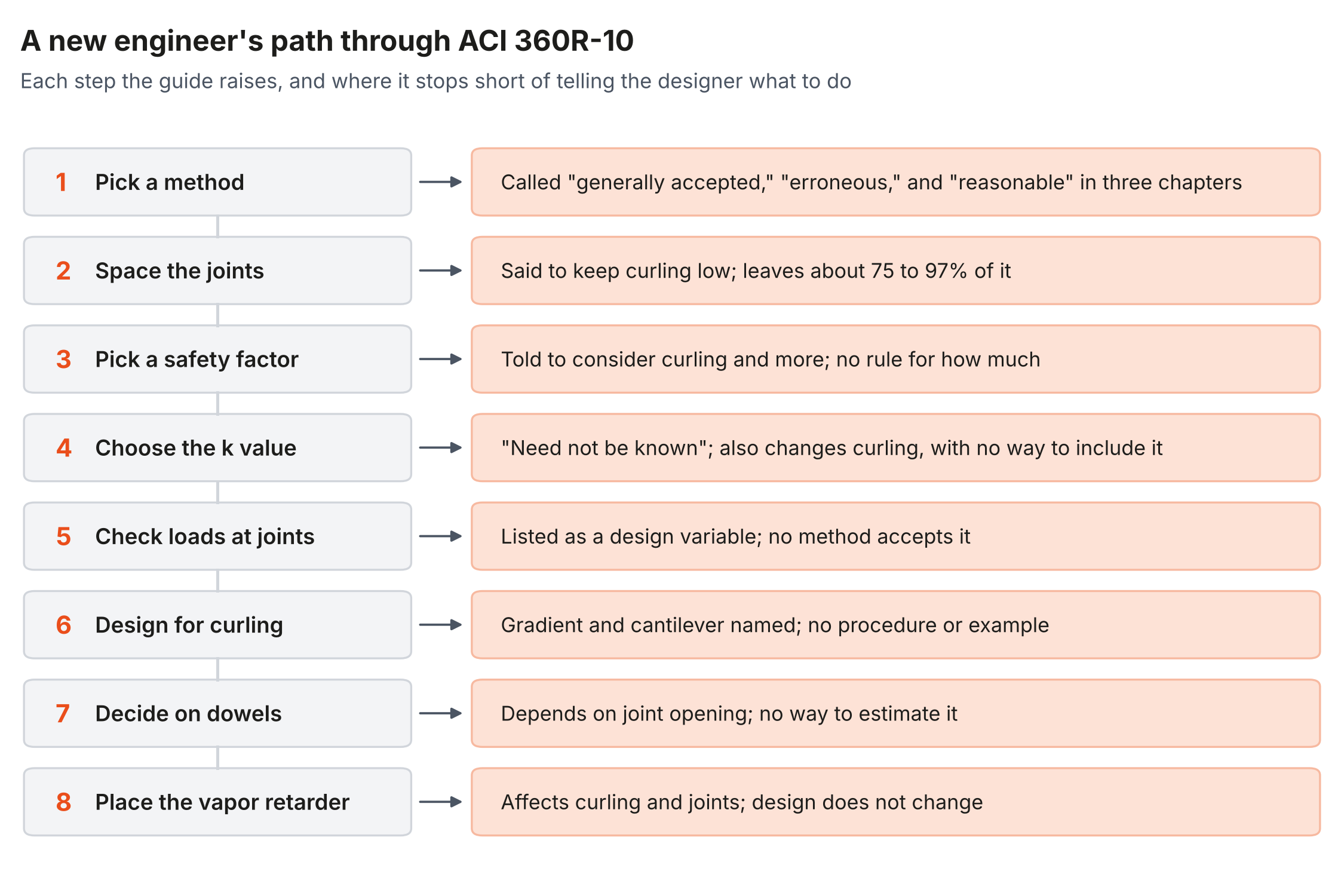
So picture that young engineer. Call her Sam. She has just been handed a warehouse floor: lift trucks, pallet racks, a typical building. She is careful, she reads the guide in order, and she assumes that what it tells her is complete. Here is what happens (Figure 1).
I should say up front that I've read the guide cover to cover more than once. George Garber said it best in his book on floors: "We all sometimes cite standards we have not read, but it's nothing to brag about." Sam reads it. That's where the trouble starts.
Step 1: Pick a design method
Chapter 7 offers Sam three thickness design methods, PCA, WRI, and COE, and calls them "generally accepted." So far, so good.
Then she keeps reading. Chapter 14, on curling, says all three methods assume the slab is fully supported by the ground, and because of that, "they give erroneous results for slab thickness where the slab is not in contact with the subgrade." Every indoor floor curls, so every indoor floor has places where it is not in contact with the ground.
Then she finds a third statement, back in Chapter 4: "By following the joint recommendations in Fig. 6.6, the curling stresses will be sufficiently low that the PCA, WRI, and COE methods will provide reasonable solutions."
So the methods are acceptable, they are erroneous, and they are fine as long as she follows a joint spacing chart. Three statements, three chapters, and no guidance on which one wins.
Step 2: Space the joints
Sam turns to Fig. 6.6, the joint spacing chart. A note on the chart says the spacings are based on "reducing the curling stresses to minimize mid-panel cracking." The text next to it says they are based on shrinkage tests of small specimens. Either way, the chart gives her a number, and Chapter 4 has told her that following it keeps curling stresses low.
It doesn't. Using the guide's own formulas and inputs, panels at those spacings still carry roughly 75% to 97% of the most curling stress they could ever develop. The resulting stresses land right in the range the guide itself reports elsewhere: 200 to 450 psi (1.4 to 3.1 MPa). I worked through the numbers in a companion paper, Joint Spacing, Curling, and the Factor of Safety in ACI 360R-10. The short version is that the chart keeps a panel from cracking under its own curl. It does not make curling small enough to ignore.
Step 3: Pick a factor of safety
This is where Sam really gets stuck.
Section 5.9 tells her to choose a factor of safety, and it gives her a thoughtful list of things to consider when choosing it: the concrete's shrinkage and curling, a humidity-controlled environment that increases curling, the smoothness of the base, the joint spacing and joint types, the number of load repetitions, and racks installed early that restrain the slab. Then Table 5.2 gives her commonly used factors of 1.7 to 2.0.
What the guide never tells her is how much any of those items should change the number. More curling: raise it by how much? A humidity-controlled building: 1.8 or 2.0? Early rack installation: does that move it at all? The guide hands her a list of ingredients and a range, with no recipe connecting them.
That matters, because the stakes are large. The guide's fatigue table says a slab designed with a stress ratio below 0.45, roughly a factor of safety of 2.2, can take unlimited load repetitions. But that ratio counts only the stress from the load. Add even 100 psi (0.69 MPa) of curling stress at the same spot, and by the guide's own table the slab is good for about 31,000 passes of the truck. Add 200 psi (1.4 MPa), the low end of the guide's own curling range, and it is good for about 360. A busy aisle uses that up in a day or two (Figure 2). Adding the two stresses is a simplification, since a curled slab loses support and the load changes it, so the real combined stress can be higher or lower than the sum. And the concrete strength in that ratio comes from a small test beam, while a slab-on-ground carries more than a beam. A complete method gets both right. The guide does neither, and even the simple arithmetic shows how much the safety factor is being asked to cover.
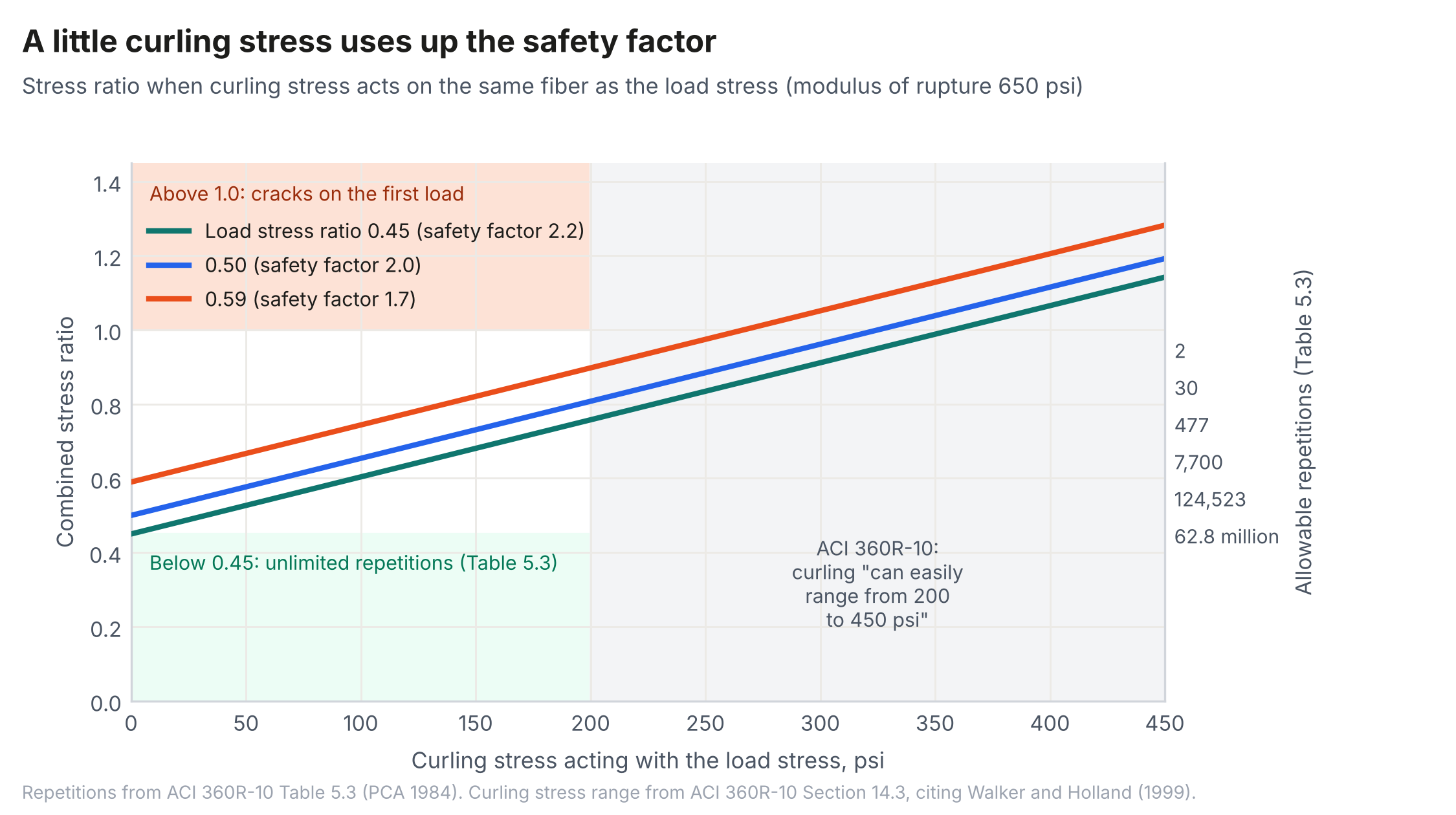
So the guide tells Sam that curling matters to the factor of safety and then gives her no way to account for it. It would be better to say nothing than to say it matters and stop there, because now she has been warned and still can't act.
Step 4: Choose the soil support value
Sam needs a modulus of subgrade reaction, the "k value," to describe how stiff the ground is. Chapter 4 tells her there is "no single k value for a subgrade." A few pages later, it tells her the thickness calculation "is insensitive to small changes in k, therefore the exact k value need not be known." It also shows her how adding a granular subbase raises the k value she can design with, which the charts reward with a thinner slab.
Then Chapter 14 tells her the opposite side of the story. A stiffer base makes curling worse, because the middle of the panel can't settle as much and the edges lift farther. The guide calls it an "anomaly" that the methods allow thinner slabs as k goes up, and closes with: "Designers should consider these factors."
Consider them how? Sam has no way to put curling into the methods, so "considering" it means nothing she can calculate. And the k-value she was handed probably came from a copied line in the geotechnical report. I take up which k-value to use, and who should own it, in Stop Asking the Slab to Fix the Soil.
Step 5: Check the loads near the joints
Racks and lift trucks don't stay in the middle of panels. The guide knows this. Chapter 5 lists "location of the concentrated load relative to slab joint location and the amount of shear transfer across the slab joint" as a design variable. Section 7.2.1.2 says to "consider also the proximity of rack posts to joints." Section 7.2 says plainly that "most of the generally used structural design methods discussed do not provide for loading at free edges and corners. The designer should carefully consider such loading."
None of the three methods has a place to enter a joint, a joint type, or how well the joint passes load. And the only load transfer data the guide gives her is a 1960s PCA result: aggregate interlock drops to 60% "joint effectiveness" once a joint opens a few hundredths of an inch. Sam reads that as 60% load transfer. It isn't. Converted to the load transfer efficiency everyone uses today, it's about 43%. The guide does print the classic edge and corner formulas, but those assume a joint that passes no load at all, and there is no example showing how to use them with dowels or with a curled slab.
The frustrating part is that a fix existed when the guide was written. The PCA method added a joint factor in its 2001 edition and expanded it in 2008, so that a load at a joint without good load transfer gets a thicker slab. The guide cites PCA, but its worked examples use the old interior charts with no joint factor.
Step 6: Design for curling
Chapter 14 tells Sam that enclosed slabs "should be designed for" an upward-curling temperature gradient of 3°F to 6°F per inch of thickness (1.7 to 3.3°C per 25 mm), and that the outer 3 to 5 feet (0.91 to 1.5 m) of each panel "might be based on a cantilever design when warping is anticipated."
Neither instruction can be carried out with what the guide provides. None of the three methods accepts a temperature gradient. There is no cantilever procedure, no load to put on the cantilever, and no example. Sam has been told what to design for and handed no way to design for it.
Step 7: Decide on dowels
Section 14.12 tells Sam to use dowels where joints are expected to open more than 0.025 to 0.035 inch (0.64 to 0.89 mm) under wheel traffic. Section 6.2 adds that where aggregate interlock is the only way load crosses a joint, joint spacing "should be the thoughtful result of an evaluation of the anticipated, activated, joint-opening widths."
So whether she needs dowels depends on how wide the joints will open. The guide never shows her how to estimate that. And when she turns to the dowel sizing table, Table 6.1, its footnote says the sizes are based on a maximum joint opening of 0.20 inch (5.1 mm), six to eight times the opening at which she was told dowels become necessary. Two different joint openings, for the same joint, with no explanation of how they relate.
To its credit, the guide knows this is a gap. Its own "Further research" section lists the need to "provide dowel recommendations based on loadings (lift truck, rack post, and uniform storage) rather than slab thickness." That was written in 2010. Sam is still waiting.
Step 8: Choose the vapor retarder location
Many floors need a vapor retarder under the slab. Chapter 14 tells Sam that a vapor retarder in direct contact with the slab "may increase slab curling," that a layer of dry granular material over it can help, and that if that layer might not be dry, it is better to place the concrete directly on the vapor retarder anyway. Section 6.2 adds that vapor retarders make dominant joints, the few joints that open wide while their neighbors stay tight, more pronounced.
All reasonable. But nothing in the thickness design, the joint spacing, or the dowel decision changes when Sam makes that choice. The guide tells her the choice affects curling and joints, then lets her design the slab exactly the same way either way.
Where Sam ends up
At the end, Sam has a thickness from an interior-load chart that assumes the slab never curls and every joint passes load perfectly. She has a factor of safety picked from a range with no way to adjust it. And she has a list of things she was told to consider but could not calculate: curling, loads at joints, joint openings, base stiffness, vapor retarder effects. Her design will come out the same whether the joints are doweled or not, whether the slab is on a vapor retarder or not, and whether the building is humidity-controlled or not.
If something goes wrong, she will also find that the guide warned about every one of those things. That is the worst position to put a young engineer in: told the risk exists, given no way to handle it, and on record as having been told.
What clear guidance looks like
I don't say any of this to embarrass anyone. The committee members I know care about floors and have spent careers on them. Most of the issues above are real, and the guide deserves credit for raising them. The problem is that raising an issue is only half of guidance.
When I was writing guidance at ACPA, we tried to hold ourselves to a simple rule: if you bring up an issue, carry it all the way through. That means one of two things. Either tell the designer what to do about it, with numbers, and show it in a worked example, or say plainly that the method doesn't cover it and point to one that does. "Consider" is not an instruction unless it comes with a way to consider.
For ACI 360R-10, that would mean:
- One clear statement of what each thickness method covers and what it doesn't, in the chapter where the designer picks the method.
- A factor of safety on the stress from curl and load analyzed together (not just added), compared with what a slab can actually carry rather than a test beam, or at least a rule for how much to adjust it.
- A joint factor, or another clear way to design for loads at joints, used in the worked examples.
- A method for estimating joint openings, so the dowel decision and the joint spacing rest on something the designer can calculate.
- A plain statement that analysis methods that include curling, loss of support, and joint load transfer exist, with guidance on inputs, since the guide already says such analysis is appropriate for slabs with joints.
None of this is new. The committee's first guide, ACI 360R-92, already said the three methods "give erroneous results for slab thickness where the slab is not in contact with the subgrade," and that microcomputers might make finite element analysis practical "in the future." The guide was revised in 2006 and again in 2010, four years later, with the same three methods and the same sentence, and it hasn't been revised since. PCA's airport method followed the same arc: first published in 1950, revised five years later, revised again in 1973, and then left alone. We're good at seeing the flaws in a first version of something. Once a method settles into specs, software, and the standard of care, we get a lot slower about fixing it, and a long record of floors that did fine starts to look like proof the method was right, instead of proof the factor of safety was big.
There's more in the technical paper
Sam's walk-through hits eight decisions. The companion technical paper, Raised but Not Resolved: An Audit of ACI 360R-10, goes much further: 25 findings, each tied to the section numbers and the guide's own wording, with a suggested fix for every one. It covers issues this article doesn't touch, like the WRI method having no published source, the COE method crediting every joint with the same load transfer, a mislabeled design table, cross-references that point to the wrong chapters, a refrigerated floor schedule that says to hold the slab at 95°F (35°C), and a joint spacing chart that kept its note about the old 24 and 36 times thickness rules after the lines themselves were removed. If you design floors, or review designs, it's worth the read.
What contractors and owners should take from this
If you build or own floors, you are not going to read ACI 360R-10 cover to cover, and you shouldn't have to. But you should know that "designed per ACI 360" does not tell you whether curling, loads at joints, or joint openings were accounted for, because the guide doesn't give the designer a way to account for them. When the floor curls, the joints rock, or a crack runs along a joint under the racks, it is usually the contractor who gets the first call.
So ask. Ask which method was used and what it covers. Ask how curling was handled. Ask how loads at joints were handled and what load transfer was assumed at each joint. A designer who can answer those questions has done more than the guide asks. A designer who can't is probably following the guide exactly as written, and that is the problem.
Sources
ACI Committee 360, ACI 360R-92 (Reapproved 1997), Design of Slabs on Grade, American Concrete Institute, 1992.
ACI Committee 360, ACI 360R-10, Guide to Design of Slabs-on-Ground, American Concrete Institute, 2010.
Colley, B. E., and Humphrey, H. A., "Aggregate Interlock at Joints in Concrete Pavements," Highway Research Record 189, 1967.
Covarrubias, J. P., Rodden, R., Khazanovich, L., Roesler, J., and Parkes, N., "Mechanistic-Empirical Design of Concrete Slabs-on-Ground," Concrete International, July 2026.
Farny, J. A., and Tarr, S. M., Concrete Floors on Ground, EB075, 4th ed., Portland Cement Association, 2008.
Garber, G., Design and Construction of Concrete Floors, 2nd ed., Butterworth-Heinemann, 2006.
Related in This Series
- Technical paper on this topic: Raised but Not Resolved: An Audit of ACI 360R-10
Audits eight design decisions in ACI 360R-10 for whether each issue raised is carried through to a design method.
- The Floor Design Guide That Calls Its Own Results Erroneous
What owners should know about the trap built into the industry's main slab design guide.
- Your Warehouse Floor Is Not a Runway
Why an airport design method ended up sizing forklift floors, and why matching inputs is not the same as matching the problem.
- If You Can't Model It, You Can't Prevent It
A plain-language summary of our Concrete International and Concrete articles, and why, in our rack example, the highest stress is where the legacy methods don't look.
- Thickness Ain't Nothin' but a Number
Why the thickest slab is often the least engineered one, and what the roads learned when they measured it.
Revision history
- November 4, 2026: Added the 1992 caution from ACI 360R-92; mentioned Finding 25.
- October 30, 2026: Added a summary of and link to the technical paper; added metric units.
- October 28, 2026: Added links to later pieces in the series.
- October 23, 2026: First published on slabs.design/knowledge.
To cite this article, use the citation printed in the PDF. It includes the revision date, so readers can match your citation to the text you read.