Article|TSD-07A
Two Promises in the Floor Design Guide That Curling Breaks
ACI 360R-10 says its joint spacing keeps curling stress low and its safety factor covers fatigue. Plug in its own numbers and neither promise holds.
The Slab Designer, LLC | Published October 28, 2026 | Revised November 4, 2026
Curl shows up 121 times in ACI 360R-10, the American Concrete Institute's Guide to Design of Slabs-on-Ground. I know because I counted. It's the 18th most common word in the document, right up there with strength and stress. Shrinkage shows up 268 times. The guide has a whole chapter on curling.
So the guide knows that every indoor floor curls. The top dries faster than the bottom, shrinks more, and the edges and corners of each panel lift. Anyone who has watched a lift truck rock across a joint, or seen a crack running parallel to a joint a foot or two in from it, has seen what that does.
It also knows the problem curl creates for its own design methods. It says curling stresses "can easily range from 200 to 450 psi," which is a big share of the strength of floor concrete. And it says the three thickness methods it presents (PCA, WRI, and COE) all assume the slab is in full contact with the ground and therefore "give erroneous results for slab thickness where the slab is not in contact with the subgrade."
So how does the guide justify using those methods on floors that curl? It makes two promises. Let's check both against the guide's own numbers.
Promise one: the joint spacing keeps curling stress low
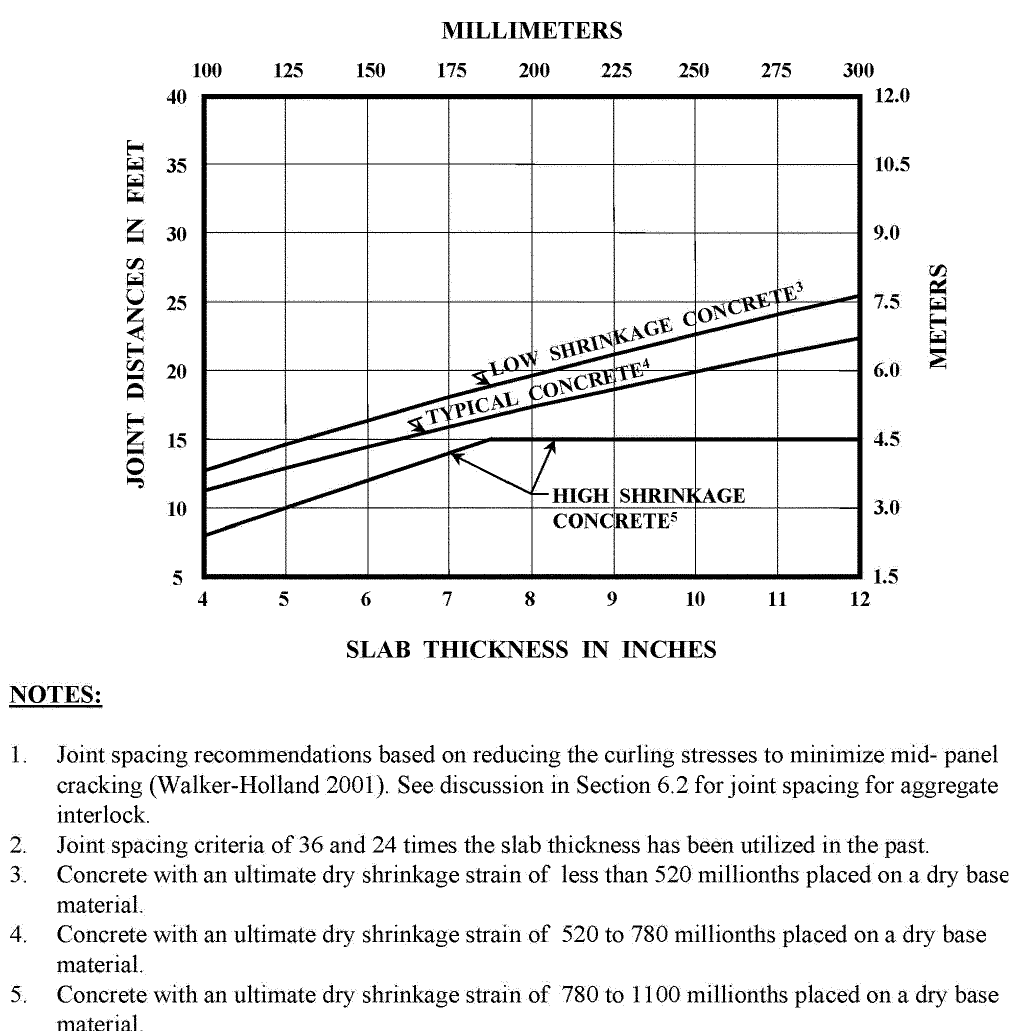
In its chapter on soils, the guide says: "By following the joint recommendations in Fig. 6.6, the curling stresses will be sufficiently low that the PCA, WRI, and COE methods will provide reasonable solutions." Fig. 6.6 is the familiar chart of joint spacing versus slab thickness. For typical concrete, it gives about 14 feet (4.3 m) for a 6-inch (150 mm) slab and about 17 feet (5.2 m) for an 8-inch (200 mm) slab.
Curling stress does depend on panel size. A very short panel barely curls. As the panel gets longer, the stress climbs, then levels off. Past a certain length, which the guide calls the critical length, it stops increasing.
The question is where the Fig. 6.6 spacings land on that curve. The guide cites the classic formula for it, from Westergaard and Bradbury in the 1920s and 1930s, and gives every input you need. Plug in the guide's numbers (Figure 2). At the Fig. 6.6 spacings, a slab on ordinary soil develops 75% to 88% of the maximum curling stress it could ever reach. On a stiffer base, 90% to 97%.
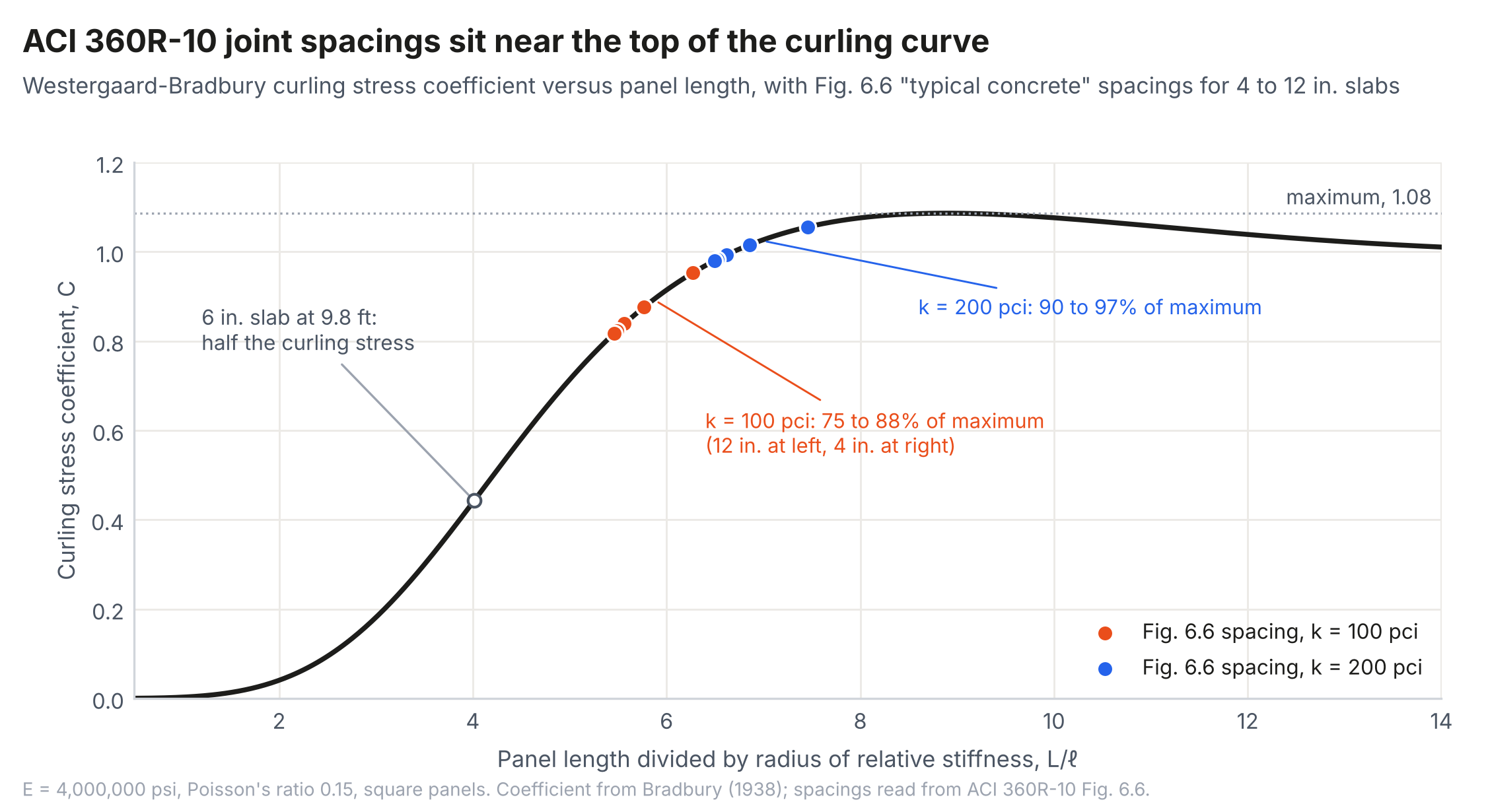
So the chart doesn't make curling stress low. It leaves most of it in place. To cut the curling stress in a 6-inch (150 mm) slab in half, you'd need joints about 10 feet (3.0 m) apart, not 14.
The stresses come out right where the guide says they will. With its recommended gradients for indoor slabs, a 6-inch (150 mm) slab at Fig. 6.6 spacing develops roughly 170 to 410 psi (1.2 to 2.8 MPa) of curling stress, and an 8-inch (200 mm) slab roughly 220 to 520 psi (1.5 to 3.6 MPa). The guide also notes that a more realistic analysis, one that lets the curled edges lift off the ground, gave stresses about 29% higher than the classic formula. So if anything, these numbers are low.
To be fair, the chart's own footnote says its spacings are based on reducing curling stress "to minimize mid-panel cracking." Read with promise one, the idea is that at these spacings curl and warp are cut enough to be of less concern when you design for loads. The numbers above say the spacings don't do that. They leave most of the curling stress in place. If joint spacing were the lever the guide meant to pull, it would have had to go shorter. That short-panel approach exists: it's the basis of TCPavements' OptiPave design method, and it has been used on interior slabs internationally and in the US, though the overall drive in slabs-on-ground has been the other way, toward fewer joints and longer spacing.
Promise two: the safety factor covers it
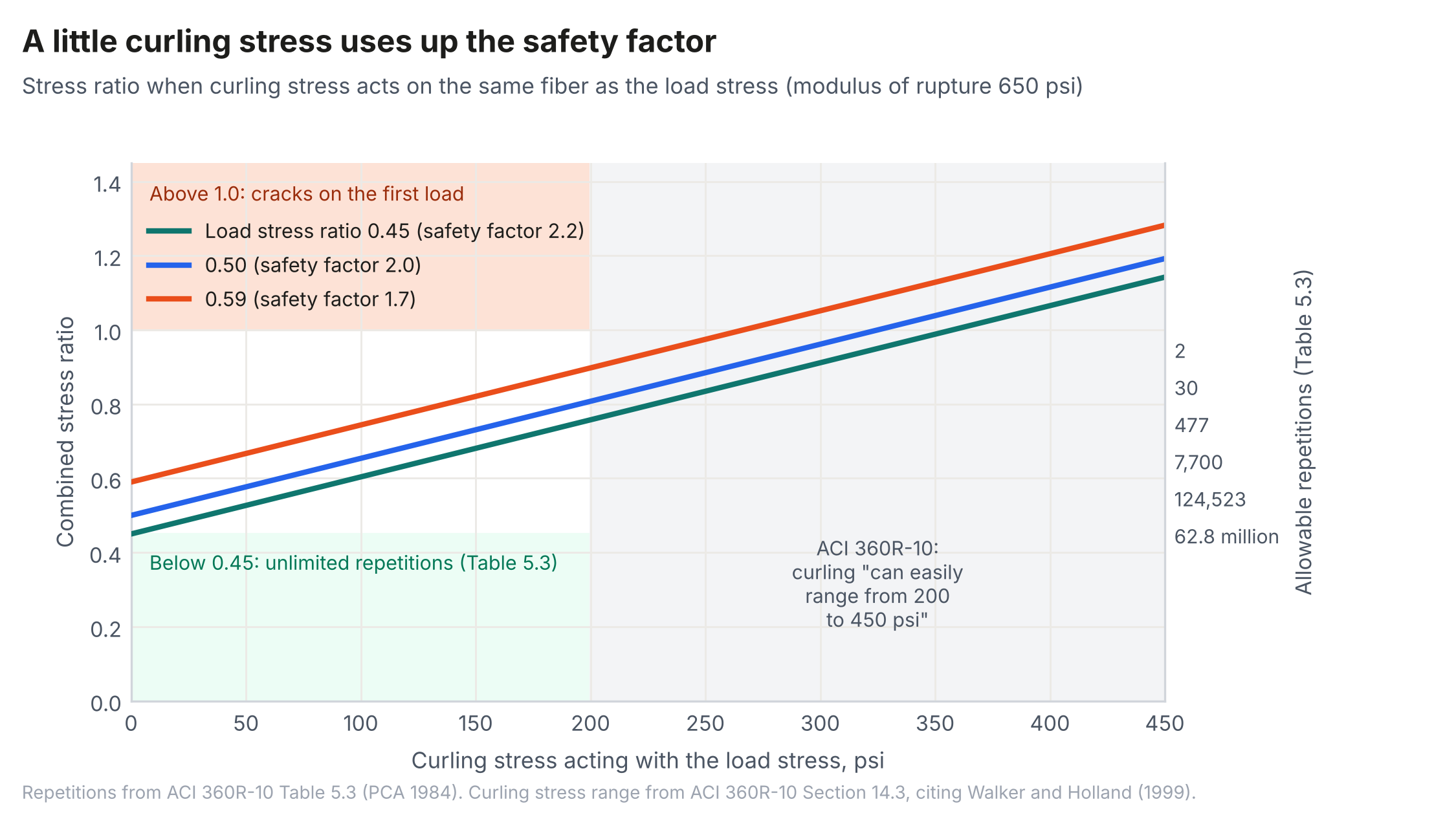
The second promise is in the design chapter. The safety factor "is the inverse of the stress ratio," the ratio of load stress to the concrete's flexural strength. Commonly used safety factors run 1.7 to 2.0. And at stress ratios below 0.45, "concrete can be subjected to unlimited load repetitions."
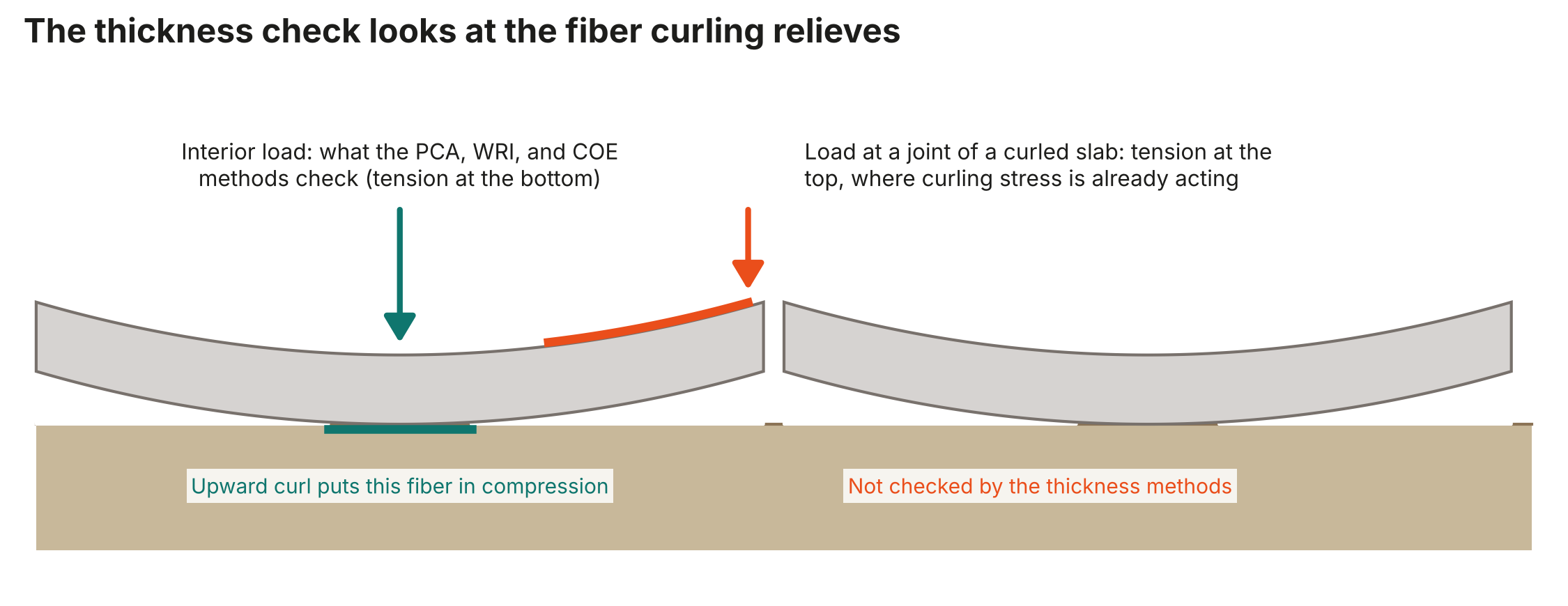
The stress in that ratio comes from the load alone. And here's the part that's easy to miss: the thickness methods calculate that stress at the bottom of the slab, under a load in the middle of a panel.
When an indoor slab curls upward, the top of the slab goes into tension and the bottom, mid-panel, goes into compression. So the place the thickness methods check is the one place where curling actually helps.
Where curling hurts is near the joints. When a wheel or rack post sits near the lifted edge of a curled panel, the slab carries it like a diving board, and that puts tension in the top. Curl already put tension in the top. The two work together. That's how floors get cracks in the middle of panels or running parallel to joints, and broken corners, and none of the three methods calculates the stress that causes them (Figure 3).
How much does that matter? The guide answers that too, with its own fatigue table. Take a slab designed to a stress ratio of 0.45, a safety factor of 2.2, which the guide says allows unlimited repetitions. Add just 100 psi (0.69 MPa) of curling stress at the same spot and the ratio becomes 0.60. The guide's table allows about 31,000 repetitions at that ratio. Add 200 psi (1.4 MPa), the low end of the guide's own range, and it drops to about 360. At the high end of the range, the combined stress is more than the concrete's strength at every safety factor the guide lists (Figure 4).
A lift truck crossing a busy joint a few hundred times a day uses up 31,000 repetitions in a few months.
One honest caveat. Simply calculating a curl stress and adding it to a load stress isn't how curl really works either. When a slab curls, it loses contact with the ground, and when a wheel rolls up to the joint it pushes the slab back down. The support changes with the load, and the stress changes with the support, so the real answer can come out higher or lower than the sum. That's why our software treats curl as an input and analyzes it together with the loads. I added the curling stress to the load stress in the numbers above only because it's the simplest arithmetic the guide's own tools allow, and even that is enough to show the safety factor isn't covering what the guide says it covers.
So why isn't every floor cracked?
Fair question, and someone will ask it. Most floors designed this way don't crack, and if the arithmetic above were the whole story, they would.
They don't because the factor of safety is bigger than it looks on paper. The biggest reason is on the strength side. The modulus of rupture we design against comes from breaking a small beam on two supports, and a slab-on-ground isn't a beam. It's supported over its whole area, it can shift load around, and it carries more than the beam test says. Compare honest stresses at a curled joint with beam strength and you'd predict cracked floors in a lot of buildings that are doing fine. That's why SLABS converts beam strength to slab capacity. Getting both the demand and the capacity right is the only way the equations can even begin to explain how these floors have actually performed.
There's more. Concrete is usually stronger than specified and keeps gaining strength. Loads rarely sit at the worst spot at the worst time. And a curled slab that lifts off the ground relaxes some of its own stress.
So the point isn't that these slabs fail. It's that the guide's methods quietly let curl eat into the safety factor, and nobody can say by how much. When something small goes wrong, like a hot pour, a stiffer base than planned, a rack leg at a joint, or a low-strength truck, the floor cracks and the design math says it shouldn't have. A method that models curl together with the load, and compares the result with what a slab can actually carry, would have shown how much of the factor of safety was really left. That's the difference between a design that worked and one we can explain.
"We've done it for years" is real experience, but it's trial and error, and it only holds while conditions match its history. Small, hard wheels, robots on fixed paths, and finer, differently blended cements all change how a floor curls and carries load. A method that includes curl doesn't dismiss that experience. It explains it, and tells you when it no longer applies.
Two promises that lean on each other
The two promises prop each other up. If the joint spacing made curling small, a safety factor on load stress alone would be reasonable. If the safety factor covered curling, the joint spacing wouldn't need to. Checked with the guide's own numbers, neither holds.
That matters beyond engineering. Owners, contractors, reviewers, and expert witnesses read the guide too. A reasonable reader of promise one would conclude that a slab designed by one of the three methods, with joints per Fig. 6.6, has dealt with curling. It hasn't, and the guide's own curling chapter says so.
The stiffer-base trap
There's one more wrinkle, and the guide points it out itself. All three thickness methods allow a thinner slab when the support is stiffer, but the curling chapter notes that a stiffer base makes curling worse and calls this an "anomaly." The old methods can't show it. Modern mechanistic-empirical methods can: it shows up in AASHTO's Pavement ME, where required thickness goes up when the support gets too stiff, as Gerald Voigt, Leif Wathne, and I showed in a 2014 comparison of pavement design methods. SLABS can show the same sensitivity when the site and slab system make it a concern.
Credit where it's due
None of this is a knock on the people who brought curl into the conversation. It's been 27 years since Wayne Walker and Jerry Holland's "The First Commandment for Floor Slabs: Thou Shalt Not Curl Nor Crack... (Hopefully)" helped the industry see how large curling stresses really are. More recently, Allen Face and Nigel Parkes showed how curl measured with a floor profiler can be converted into an effective built-in temperature difference that mechanistic-empirical design tools can use. That's the direction we need: designs based on measured slab behavior, not assumed conditions.
What should change
None of this needs new research. Every number here is already in the guide. What the guide needs is for its thickness chapter to agree with its curling chapter:
- Stop saying Fig. 6.6 makes curling stress low. Say what it does: limit cracking from curling alone.
- Add a check for the top of the slab near joints, where loads and curling work together.
- Base the safety factor on the combined stress at that spot, or at least take an estimate of curling stress out of the concrete strength before applying it.
- Show designers how joint spacing, thickness, and base stiffness change curling stress, so they can see the trade-offs.
- Point designers to analysis methods that include curling, loss of support, and load transfer at joints, which the guide already says are appropriate for jointed slabs.
Until then, if you're designing or specifying a floor, don't assume the joint spacing chart or the safety factor took care of curling. Ask how it was handled. And if racks or traffic sit at joints, make sure somebody looked at the top of the slab.
Sources
ACI Committee 360, ACI 360R-10, Guide to Design of Slabs-on-Ground, American Concrete Institute, Farmington Hills, MI, 2010. Section 4.4.7, Chapter 5 (Tables 5.2 and 5.3), Fig. 6.6, and Sections 14.1, 14.2, 14.12, and 14.13.
Bradbury, R. D., Reinforced Concrete Pavements, Wire Reinforcement Institute, Washington, DC, 1938.
Covarrubias, J. P., Rodden, R., Khazanovich, L., Roesler, J., and Parkes, N., "Mechanistic-Empirical Design of Concrete Slabs-on-Ground," Concrete International, July 2026.
Face, A., and Parkes, N., "Addressing Concrete Slab Curl Numbers," ForConstructionPros, 2026.
Leonards, G. A., and Harr, M. E., "Analysis of Concrete Slabs-on-Ground," Proceedings, ASCE, Vol. 85, SM3, 1959.
Walker, W. W., and Holland, J. A., "The First Commandment for Floor Slabs: Thou Shalt Not Curl Nor Crack... (Hopefully)," Concrete International, Vol. 21, No. 1, January 1999.
Walker, W. W., and Holland, J. A., "Design of Unreinforced Slabs-on-Ground Made Easy," Concrete International, Vol. 23, No. 5, May 2001.
Rodden, R., Voigt, G., and Wathne, L., "Comparison of Roadway Jointed Plain Concrete Pavement (JPCP) Thickness Design Methods Common in the United States," Proceedings, 12th International Symposium on Concrete Roads, 2014.
Westergaard, H. M., "Analysis of Stresses in Concrete Roads Caused by Variations of Temperature," Public Roads, Vol. 8, No. 3, 1927.
Related in This Series
- Technical paper on this topic: Joint Spacing, Curling, and the Factor of Safety in ACI 360R-10
Checks the Fig. 6.6 joint spacing and the Table 5.2 factor of safety against the guide's own curling and fatigue data.
- Stop Asking the Slab to Fix the Soil
Where 'CBR 3 = k 100 psi/in.' came from, why a settlement-reduced k-value isn't a stiffness, and who should own long-term settlement.
- Spec Building Floors: Why Undoweled, Doweled, and 0.1% Steel Slabs Should Not Share One Thickness
The joint detail changes how thick a spec building slab needs to be, and the cost numbers say doweling pays.
- The Floor Design Guide That Calls Its Own Results Erroneous
What owners should know about the trap built into the industry's main slab design guide.
- A Little Steel Through the Sawcut Is Not as Harmless as the Table Says
The 0.1% limit for continuous steel through sawcuts rests on a table that answers a different question than the joints ask.
Revision history
- November 4, 2026: Added ACI's recommended joint spacing chart; noted short-panel use in the US.
- November 3, 2026: Completed references; added metric units and links to other pieces in the series.
- October 30, 2026: Added why experience alone isn't enough as conditions change.
- October 28, 2026: First published on slabs.design/knowledge.
To cite this article, use the citation printed in the PDF. It includes the revision date, so readers can match your citation to the text you read.